
EPiC
A Note on Obsession

Baz Luhrmann has resurrected Elvis again, and this time, no Austin Butlers were harmed. The Australian voluptuary’s new film, creatively titled EPiC: Elvis Presley in Concert, was released exclusively in IMAX yesterday, February 20, and expands to theaters worldwide next Friday. Personally, I’ve been dreaming of premiere day ever since Luhrmann took to Instagram years ago to post a cryptic, flamboyant video about a project involving “lost” Elvis footage. I bought my IMAX tickets last month (I received e-mail updates on their availability), and yes, I know that some of you are thinking, “Of course she did.” Oh well. To paraphrase my former psychopomp, Hunter S. Thompson, once you get locked into a serious Elvis fixation, the tendency is to push it as far as you can.
My mom reminded me of the meaning of the word “psychopomp” during a recent conversation about The Divine Comedy, the 14th century poem by Dante Alighieri. In the poem, Dante, an Italian softboy, experiences a midlife crisis that literally takes him through Hell. By his side is Virgil, a Roman poet who died in 19 BCE. In mythology and folklore, psychopomps, like the Grim Reaper, shepherd the newly deceased to the next place, but Virgil is different: he doesn’t lead Dante to the Inferno, but through it, and since “psychopomp” translates to “guide of souls,” we can rest assured that Virgil belongs in the literary ‘pomp pantheon.
Now, I don’t know about you, but I’ve crawled my way through the Underworld a few times, and I am very comfortable with the idea of being bolstered by artists who are good n’ dead. For instance, Freddie Mercury once helped me through a challenging time at work when I needed to remember that I was a superstar. Years later, during the summer of 2023, SAG-AFTRA and the WGA both went on strike, and my nascent freelance career fizzled like a casual romance. Thankfully, James Dean took me to the intersection where his Porsche 550 Spyder crashed, and while the adventure didn’t lead to a paying job, it did lead to a couple thousand words. Last night, as I sat down to write, Eve Babitz appeared across from me at my table. She wished me luck and told me to have fun, and when I said that I felt anxious, she advised me to knock it off.
“Just do what you always do,” she said, “and tell the truth in your weird, horny way.”
See? I collect psychopomps. No biggie.
I’m actually relieved to remember the word “psychopomp” because now I can wield it when people ask me why I love Elvis. In the past, I’ve struggled to answer that question succinctly, especially since my first instinct is to methodically list all the awful things Elvis did in his life and then try to explain why I still love him. The only time my messy Elvis feelings were immediately understood was when a successful writer asked me if I was working on anything. When I told her that I was constantly scribbling about Elvis, she asked me what I liked about him.
“I’m fascinated by his whole story” I said. “I know it’s weird, but learning about him helped me re-calibrate my system after the pandemic temporarily turned me into a paranoid shut-in.”
I expected her to look at me like I had two heads, but she didn’t.
“I love this,” she said.
“You do?”
“Keep going with all of it,” she said. “Go even harder. Artists are obsessed.”
Baz Luhrmann would agree. EPiC is an ode to obsession. He didn’t make a documentary, per se, but he did make a piece of art—one that may remind the viewer of a giant, colorful collage. If you’ve ever obsessed over a collage, you know there’s a perfect place for every bit of paper, lace, or plastic. All you have to do is re-arrange them all again and again until that final gear clicks in your brain and you’re left with an orchestrated accident.
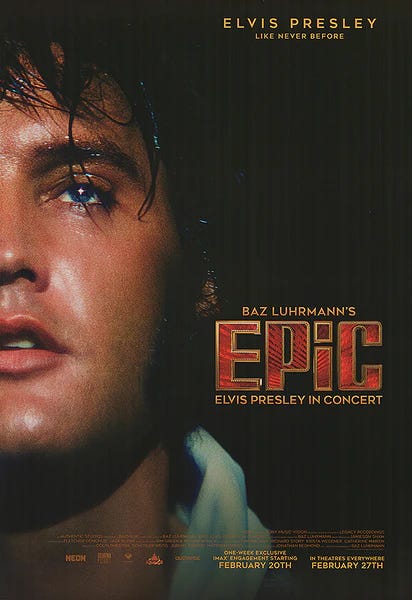
Throughout EPiC’s 100-minute runtime, it obsessively weaves together largely unseen footage of Elvis on and off stage. Filmed rehearsals are seamlessly intercut with live performances; a backstage a cappella jam bleeds into a clip of a press conference; a sweaty, lustful performance of “Polk Salad Annie” is interrupted by a haunting black and white portrait of Elvis and his parents. A few transitions feel surprising (it is a Baz Luhrmann movie, after all), but they are never random. There’s a method behind this madness, and that method, while quite mad, is exacting.
Luhrmann isn’t the only obsessive in this film. The women crying in their seats at the International Hotel in Las Vegas are obsessed. Colonel Tom Parker, Elvis’ vampiric, exploitative manager, is obsessed. Even Elvis, the tall drink of water with the voice of an angel and the mind of a child, is obsessed with the way his band sounds. Waving his arms like a crazed conductor, he leads them during both practices and performances, twisting and contorting until he gets the sound he wants. His act always looks unpolished, but that’s because he put in the work. He was obsessed.
I didn’t cry at the end of EPiC. I did, however, feel a wave of gratitude. How wonderful to be obsessed. I sat in the dark and giggled as I remembered a bad date I went on weeks ago. The guy—the dud— wasn’t obsessed with anything, but after about an hour of bland chat, when he went in for a kiss, he suddenly became obsessed with trying to take me home. After at least my fourth or fifth “not tonight,” I looked at the flat screen TV on the wall behind him. A commercial for EPiC was playing on mute. When the dud asked me if I was into Elvis, all I told him was, “He’s my psychopomp.” I like to think (or, perhaps, I know) that Elvis showed up on the TV screen to make sure I was okay—as if he was peaking in from the spiritual realm to say, “Stay away from this one, baby.”
The credits ended, and as my friend and I stood up to leave, I reached down and clutched the large soda I had bought before the movie. It was only half finished, but I knew I’d need a caffeine boost later.
I should go home and get to work, I thought.
Here to quote you quoting someone else back to you "Keep going with all of it...Go even harder"